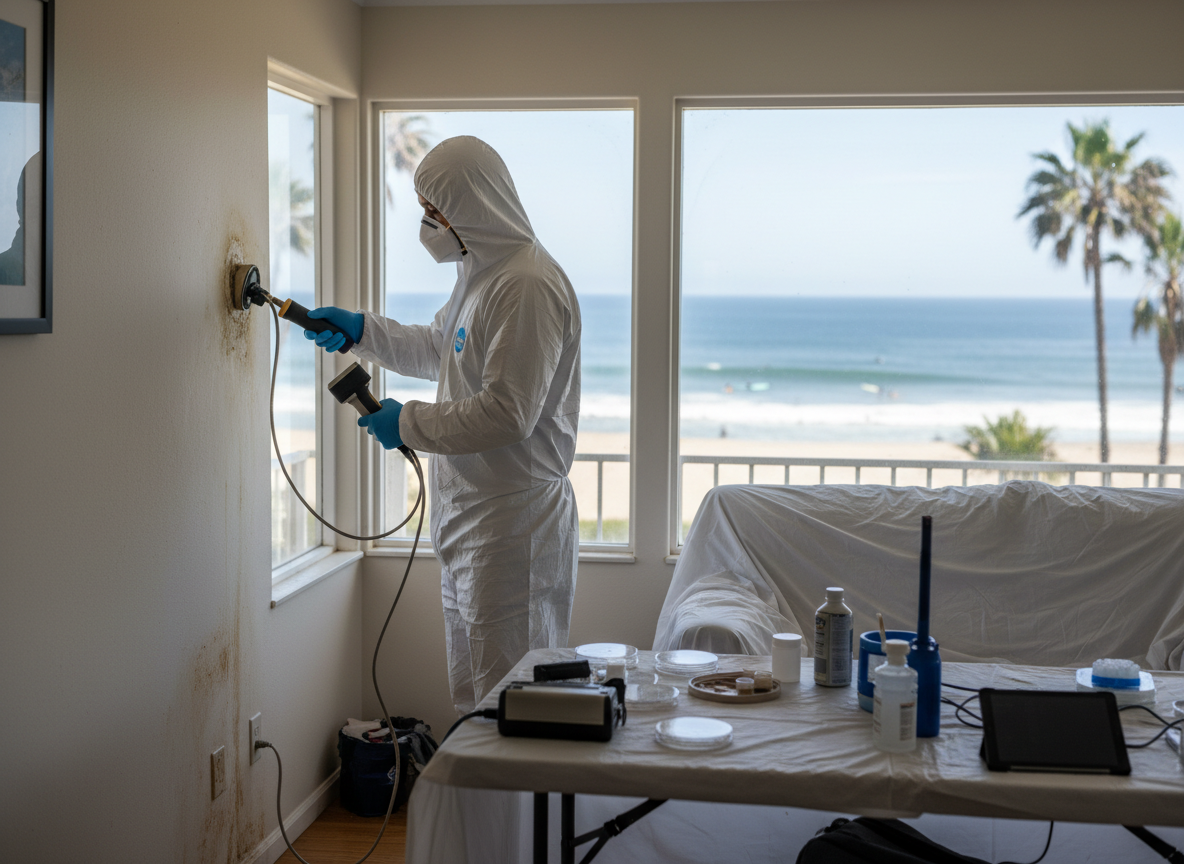
Cardiff By The Sea sits right on the Pacific with persistent marine layer moisture that seeps into crawl spaces and wall cavities of homes built from the 1950s through the 1970s. These older single-story and split-level properties often have unlined ducts and single-pane windows that allow condensation to form on cooler surfaces. When we test, we focus on air sampling from multiple zones including attics above the living space and under-house areas where the ground stays damp year-round. Lab results frequently show elevated spore counts even when visible growth is absent because the constant 70-75 percent relative humidity prevents surfaces from drying out between fog events.
Testing protocols here differ from inland San Diego neighborhoods because salt air corrodes metal registers and coil fins faster, creating hidden biofilm inside HVAC plenums. We pull both spore trap and tape lift samples from supply and return runs plus surface swabs from bathroom exhaust fans that vent into attics rather than outdoors. Homeowners commonly overlook the laundry rooms in Cardiff By The Sea's smaller beach cottages where dryer vents terminate too close to foundation vents, pushing warm moist air directly under the floor joists. Accurate testing requires shutting down the system for at least four hours beforehand so we capture settled rather than disturbed particles.
Results include a written report with chain-of-custody documentation and specific remediation recommendations tied to the property's construction type. We note whether the home has a raised wood floor over a crawl space or slab-on-grade, because each requires different air exchange calculations. Post-rain events in winter months often push readings higher in neighborhoods like Composer District and Cardiff Cove where drainage slopes toward the structures. The report flags any areas needing targeted follow-up inspection rather than broad remediation.
Technician insight
In Cardiff By The Sea, the thing that catches most people out with Air quality and mold testing is how the constant salt air corrodes older galvanized ducts in homes built before the mid-1980s, trapping moisture and mold inside the runs that only shows up when you pull samples from both supply and return sides after the system has sat idle overnight.
Musty Odor After Winter Rains
A Cardiff By The Sea homeowner noticed a persistent earthy smell in the living room after several days of heavy coastal rain. We mapped elevated humidity in the crawl space and pulled air samples from the central return and two bedrooms. Lab results showed higher indoor aspergillus/penicillium counts than the outdoor control. We recommended targeted drying of the subfloor and duct cleaning rather than whole-home remediation.
How it works
- 1
Site Walk And Moisture Mapping
We inspect the full property including crawl space, attic, and HVAC access points while recording humidity levels and visible water stains.
- 2
Air And Surface Sampling
Spore traps, tape lifts, and swabs are collected from HVAC runs, living areas, and suspected moisture zones with proper chain of custody.
- 3
Laboratory Analysis
Samples go to an accredited lab for genus identification and concentration counts compared against outdoor control samples.
- 4
Detailed Report Delivery
Findings are compiled into a written report with photos, lab data, and prioritized next-step recommendations for the specific Cardiff By The Sea address.
Pricing
Pricing varies by property size, number of samples, and whether HVAC access is required; contact for an upfront quote.