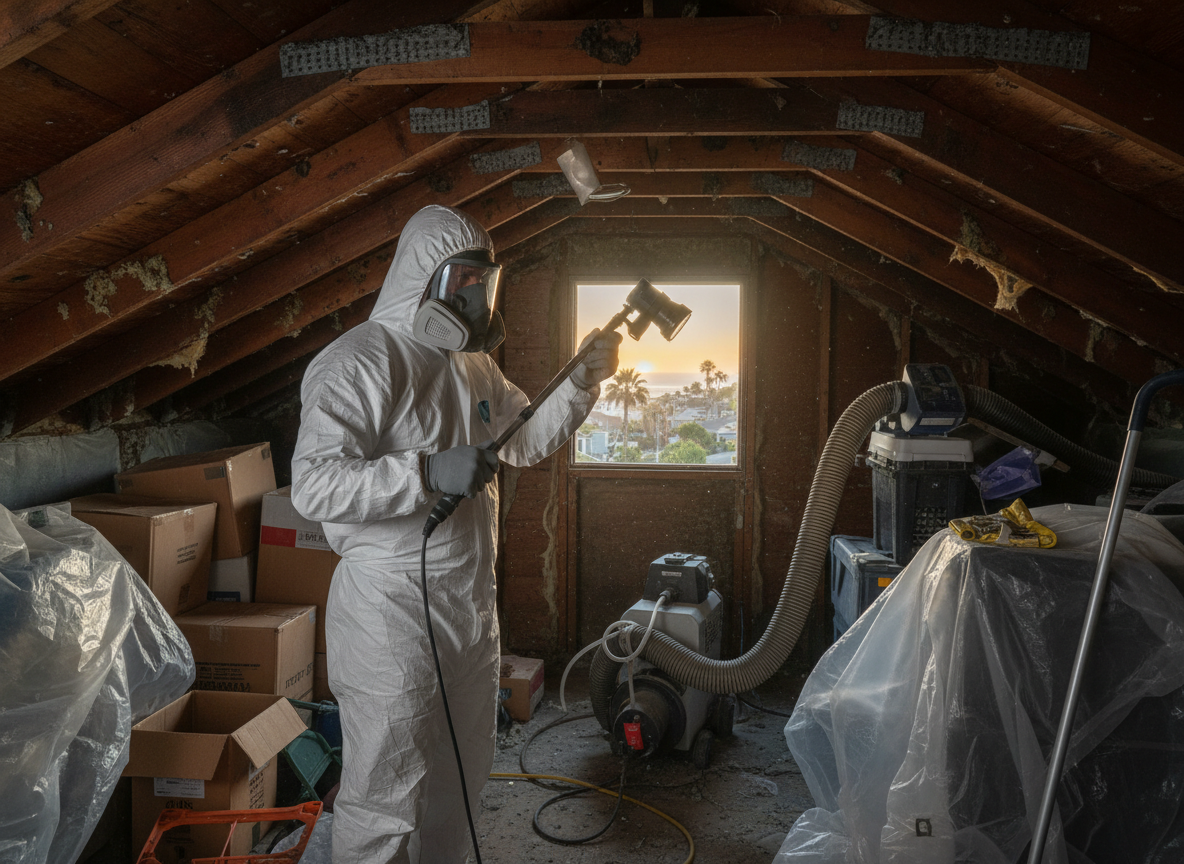
Attic mold in Cardiff By The Sea often starts from condensation under roof decks where marine layer fog meets older fiberglass batt insulation. Homes built before the 1980s frequently lack ridge vents or have blocked soffits from insulation settling, trapping moisture that never dries. We begin with moisture mapping and air sampling to distinguish between surface growth and hidden colonies inside rafter bays before any removal begins.
Removal work must respect the tight access typical of Cardiff By The Sea attics, where low headroom and knee walls make full containment challenging. We isolate the space with floor-to-ceiling poly barriers sealed at the ceiling joists, then use negative air machines exhausted through a window to prevent spores from drifting into living areas below. Porous materials like cellulose or wet drywall backing are cut out and bagged on site rather than treated in place.
After physical removal we apply an EPA-registered antimicrobial to structural wood only when staining remains, followed by HEPA vacuuming of all surfaces. Final clearance includes post-remediation air sampling and a written report noting any ventilation upgrades needed to keep relative humidity below 55 percent during the damp winter months common along Birmingham Drive and surrounding streets.
Homeowners sometimes discover the issue only after a roof leak from winter storms or when selling a property and receiving an inspection note. In these cases we coordinate with local roofing contractors familiar with the clay tile roofs prevalent in the neighborhood so the attic work happens before new underlayment is installed.
Technician insight
In Cardiff By The Sea, the thing that catches most people out with Attic mold testing and removal is how the constant marine layer creates condensation right under the roof deck even when there is no roof leak; older homes along Birmingham Drive often have settled insulation blocking the only soffit vents, so the mold keeps returning until ventilation is improved.
Hidden Growth Behind Knee Wall
A Cardiff By The Sea homeowner noticed musty air when accessing storage in the attic. We found elevated moisture behind a knee wall where the marine layer had been condensing for months. After mapping and sampling we removed the wet insulation, treated the framing, and added a ridge vent to restore airflow.
How it works
- 1
Initial Assessment
Visual inspection and moisture readings throughout the attic space to locate active and dormant growth.
- 2
Air And Surface Sampling
Collect samples for lab analysis to confirm mold types and spore levels before any disturbance.
- 3
Containment Setup
Install sealed barriers and negative air to protect the rest of the home during removal.
- 4
Removal And Cleaning
Extract affected materials, treat remaining surfaces, and HEPA vacuum all attic contents.
- 5
Clearance Testing
Post-work air sampling and report delivered to confirm levels have returned to normal.
Pricing
Cost depends on attic size, extent of growth, and whether insulation replacement is required.