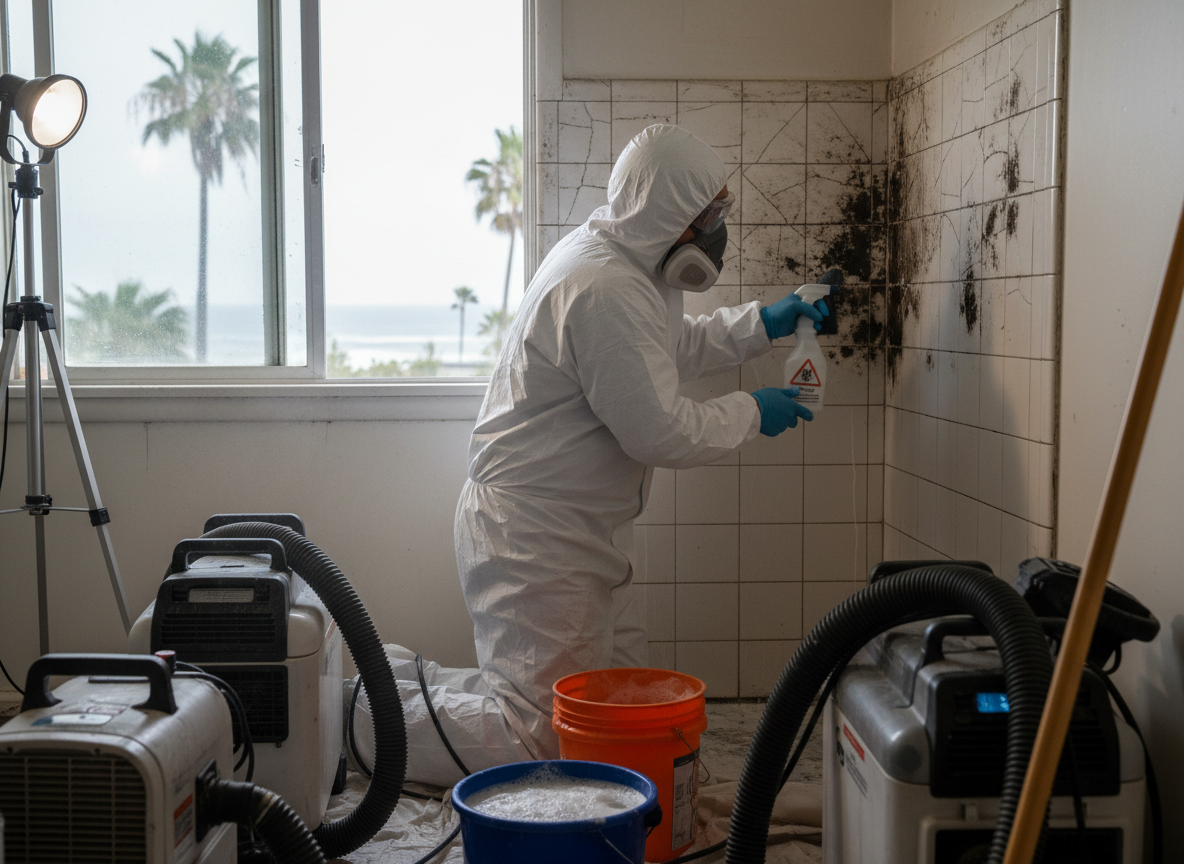
Bathrooms in Cardiff By The Sea homes often develop mold along grout lines, behind vanities, and in ceiling corners because ocean humidity combines with poor exhaust fan performance. Older stock near Birmingham Drive and along the lagoon edges frequently has single-pane windows and minimal insulation that lets warm moist air linger after showers. Removing surface growth without cutting into drywall leaves roots intact and allows rapid return once the next marine layer moves in.
We isolate the room with plastic sheeting and negative air machines before any demolition begins. Every layer of drywall, baseboard, and insulation is inspected because mold travels along the back side of tile and into the subfloor framing. After removal we apply EPA-registered antimicrobials and run commercial dehumidifiers until moisture readings drop below 15 percent on both wood and drywall.
Final clearance includes a third-party air sample and a written report that homeowners can share with insurance or future buyers. We also check adjacent rooms because the coastal breeze pushes spores through shared wall cavities in duplexes and townhomes common in this neighborhood.
Technician insight
In Cardiff By The Sea the thing that catches most people out with bathroom mold removal service is how quickly ocean humidity re-soaks the wood framing once the shower runs again; homes built before the 1990s along the lagoon often have no ridge vents, so even after we dry the room the next marine layer pushes moisture back into the same cavities if the exhaust fan isn't upgraded.
Hidden growth behind vanity in Cardiff lagoon cottage
Homeowner noticed black spots on grout but ignored a musty smell after showers. We found the vanity had been installed over saturated drywall that extended into the wall shared with the hallway. After removing the cabinet and two feet of drywall we treated the studs and ran dehumidifiers for 48 hours; clearance samples passed and the owner was able to reinstall a new vanity without further issues.
How it works
- 1
Initial Assessment
Walk the bathroom and surrounding rooms with moisture meters and borescopes to map every affected surface without disturbing settled spores.
- 2
Containment Setup
Seal doorways and vents, then establish negative pressure so air moves only inward during demolition.
- 3
Removal and Cleaning
Cut out saturated drywall and baseboards, HEPA vacuum all surfaces, then treat with antimicrobial solution.
- 4
Drying and Verification
Run dehumidifiers until readings stabilize, followed by independent air sampling for clearance.
Pricing
Cost depends on square footage affected, whether subfloor or framing must be opened, and how many adjacent rooms require inspection.