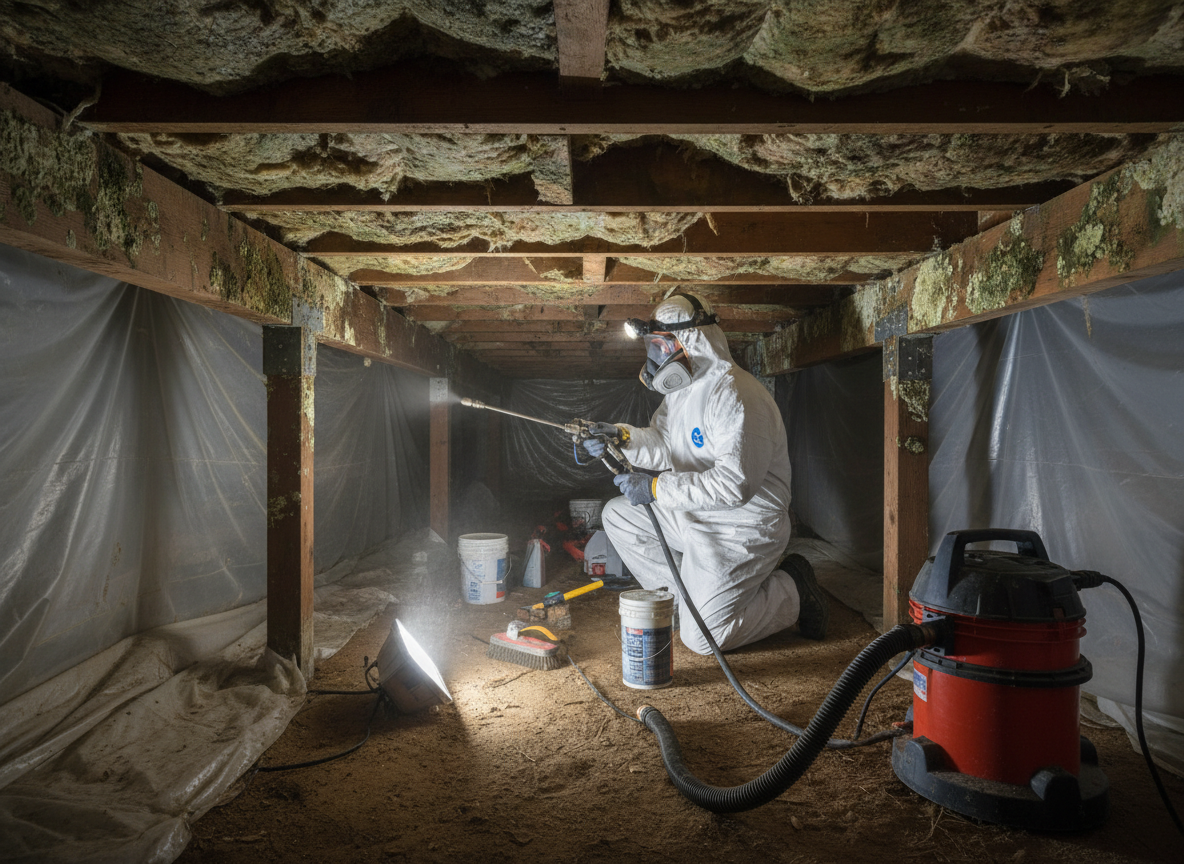
Crawl spaces in Cardiff By The Sea homes built before the mid-1980s often sit directly on native soil with minimal vapor barriers. Ocean fog rolls in most evenings and lingers, raising humidity levels under the floor joists even when the rest of the house feels dry. When insulation becomes saturated, black mold colonies spread along the rim joists and HVAC ducts that run through the space. Removing the growth requires sealing off the living area above, HEPA vacuuming loose spores, and applying antimicrobial treatments to the wood before any new insulation or encapsulation can be installed.
Access is frequently the first challenge. Many properties along Birmingham Drive and in the Composer District have crawl space entries only 18 inches high, forcing technicians to work on their backs while wearing full PPE. Soil moisture from the nearby San Elijo Lagoon can wick upward through the dirt floor, so simply drying the air is not enough. We install temporary dehumidification, remove affected insulation, and treat the exposed soil with a penetrating fungicide before laying down new 6-mil reinforced vapor barrier sealed to the foundation walls.
Cardiff By The Sea sits in San Diego County’s coastal zone where building codes now require mechanical ventilation in new crawl spaces, yet many older homes still rely on passive vents that clog with salt air debris. Homeowners often notice musty odors in closets or higher utility bills before visible mold appears. Addressing the source means improving airflow and sometimes adding a small dehumidifier sized for the square footage, rather than repeated surface cleaning that fails within a season.
After remediation we always recommend a follow-up inspection once the space has dried for at least two weeks. This confirms that moisture levels have dropped below the 60 percent threshold where mold can regrow. We document conditions with photos and moisture meter readings so homeowners have a clear baseline for future maintenance.
Technician insight
In Cardiff By The Sea the thing that catches most people out with crawl space mold removal is the salt-laden fog that keeps soil moisture high even after we dry the air. Homes near Birmingham Drive and the lagoon often have 1960s-era vents that are too small and constantly clogged, so the real fix is improving airflow and sealing the dirt floor, not just spraying the joists once.
Musty Odor Under Kitchen Floor
A homeowner on Birmingham Drive noticed a persistent earthy smell in the kitchen. We found black mold along the rim joists where ocean fog had kept the crawl space humidity above 70 percent for months. After containment, HEPA cleaning, insulation removal, and a sealed vapor barrier installation, the odor disappeared and moisture readings stayed under 55 percent.
How it works
- 1
Initial Assessment
We enter the crawl space from the exterior access point, measure moisture content in joists and soil, and map visible mold growth while checking for HVAC or plumbing leaks.
- 2
Containment Setup
Plastic sheeting and negative air machines isolate the crawl space from the living area above to prevent spore migration during cleaning.
- 3
Removal and Treatment
HEPA vacuuming, antimicrobial application, and removal of saturated insulation are completed, followed by treatment of the soil floor.
- 4
Drying and Encapsulation
Dehumidifiers run until readings stabilize, then a sealed vapor barrier is installed and vents are cleared or upgraded.
Pricing
Cost depends on crawl space size, access difficulty, and whether insulation replacement or encapsulation is required.